

Top 10 Industrial Air Compressors That Deliver Unmatched Performance and Durability
2026-08-22
Air compressors are the unsung heroes of countless industrial operations, yet finding one that truly balances raw performance with long-term durability can feel like a gamble. Too many units promise power but falter under pressure—literally. That’s why we’ve cut through the noise and tested the market's toughest contenders. From high-demand manufacturing floors to relentless construction sites, these machines prove their worth. And when reliability is non-negotiable, brands like Seize Air have built a reputation for engineering compressors that refuse to quit. Ready to meet the top 10 that deliver the muscle and the stamina your operation deserves? Let’s dive in.
The Real Reason Most Compressors Fail Early
Most early compressor failures don't begin with a seized bearing or a cracked valve plate. They start weeks or months earlier, when the oil film thins out due to short cycling and the crankcase never reaches the temperature needed to boil off condensed moisture. That milky residue you see on a dipstick is not just cosmetic; it acidifies the oil, eats away at polished surfaces, and turns every cold start into a metal-on-metal event. By the time the unit trips on thermal overload, the damage has already spread through the rod and main bearings.
Air filtration is another quiet killer. A compressor drawing in dirty air passes abrasive particles straight into the cylinder bore and rings. Once the rings lose their edge, blow-by increases, discharge temperatures climb, and the oil begins to coke inside the discharge line. That coked oil then hardens into carbon flakes that wedge under valve reeds, causing them to flutter and break. The failure is often blamed on the valve, but the real fault lies upstream with a $10 filter element that no one replaced.
Mounting orientation and ambient conditions also get overlooked until it's too late. An air receiver tilted the wrong way or placed against a hot wall will store less usable air and force the pump to run longer than it should. Each extra minute of runtime below full operating temperature adds another layer of moisture and acid to the oil. The compressor doesn't die from a single bad component. It dies from a chain of small neglects that people mistake for normal wear.
How to Spot a Rotary Screw That's Built to Last
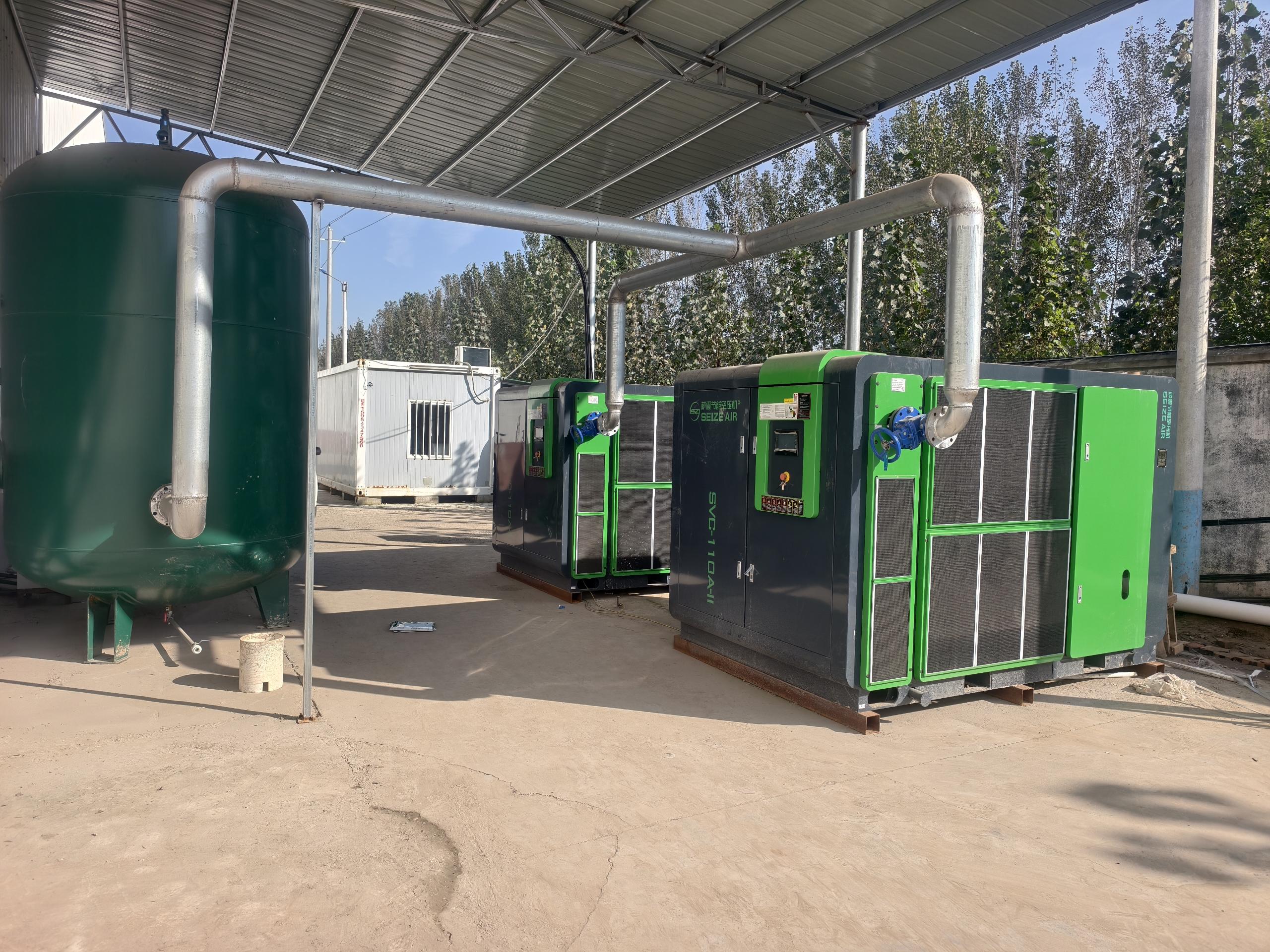
Start with the casing and end plates. A rotary screw that’s meant to survive hard cycles will have thick, ribbed cast iron or ductile iron housings, not thin stamped covers. Run a finger along the machined mating surfaces—if you feel uneven gaps or see excessive sealant squeeze-out, that’s a sign of loose tolerances. Long-life units also use dowel pins or tongue-and-groove joints between the rotor bore and bearing bores, which keep alignment stable under thermal load instead of relying on bolts alone.
Next, look at the rotors and bearings. The rotor flanks on durable machines are precision-ground and often coated, with a dull gray or matte finish rather than a shiny polished look that hides poor profile consistency. Open the bearing spec sheet: oversized cylindrical or taper roller bearings on the discharge end, plus a separate thrust bearing, usually indicate the builder expected axial and radial loads to be handled separately. If the manufacturer won’t share bearing numbers or rotor clearance data, walk away.
Finally, trace the oil path. Built-to-last screws use full-flow filtration with a bypass valve that opens only during cold starts, not a cheap strainer that lets debris circulate. Look for steel or brass fittings instead of plastic, and check whether the separator tank has a low oil carryover spec—under 3 ppm at rated pressure is a good benchmark. A unit that includes an hour meter, vibration pads, and a documented run-in test with recorded temperatures usually comes from a line that cares about the next decade, not just the first 500 hours.
Why CFM Ratings Alone Won't Tell You the Whole Story
CFM, or cubic feet per minute, is often the first number people check when comparing fans, range hoods, or air purifiers. It tells you how much air a unit can move, but not how effectively it moves that air in real conditions. A high CFM rating can be misleading if the ductwork is restrictive, the fan blades are poorly designed, or the motor loses power under pressure. In many cases, a lower-CFM unit with better engineering will outperform a higher-CFM unit that chokes on backpressure or dissipates airflow through leaks and turbulence.
The missing pieces are static pressure and system resistance. Static pressure measures how hard the fan has to work against obstacles like bends, filters, and long duct runs. A fan rated at 400 CFM in free air might drop to 200 CFM once installed, while a purpose-built fan with a stronger motor curve holds closer to its rating. Similarly, air velocity and capture efficiency matter more than raw volume in kitchens— a hood that pulls 600 CFM but only captures a narrow plume of smoke will leave the room greasier than a 350 CFM hood with a wider, deeper capture area. Always ask for the fan curve and real-world test data, not just the box number.
The Role of Cooling Systems in Daily Heavy Use
When a machine runs for hours on end, the cooling system stops being a background feature and starts dictating how well everything else functions. Heat builds up in ways that aren't always obvious—bearings expand, lubricants thin out, and electronic components drift from their calibrated tolerances. A well-designed cooling loop doesn't just prevent failure; it keeps the entire system within a narrow band where performance stays predictable. Without that stability, even small tasks start to feel sluggish or erratic.
Daily heavy use exposes weaknesses that occasional operation never reveals. Fluid levels drop, fins clog with dust, and pumps wear down gradually. The real challenge isn't the initial heat load—it's the cumulative effect over weeks and months. Components that run slightly hot today might survive, but they age faster than identical parts kept cool. This is why routine maintenance matters more than peak cooling capacity: a system that's easy to inspect and clean will outperform a more powerful one that's neglected.
There's also the human side to consider. Operators working near hot equipment get tired sooner, make more mistakes, and may push machines harder to finish before conditions worsen. A cooling system that runs quietly and consistently lets people focus on the task instead of the heat. In practice, that means sizing radiators, fans, and coolant flow for the worst typical day—not the best-case scenario. When the load is constant, cooling isn't just a safety feature; it's part of the productivity equation.
What a 24/7 Duty Cycle Actually Demands From the Machine
Running continuously isn't just a matter of leaving the motor on. Every bearing, seal, and contact surface experiences thermal cycling that never fully relaxes. Components that would normally cool overnight instead hover near their upper temperature limits, which accelerates oxidation of lubricants and softens insulation varnish. The real demand is on materials that must tolerate this steady-state stress without drifting out of tolerance.
Electrical systems face a quieter but equally relentless challenge. Capacitors and power semiconductors degrade faster when they don't get periodic rest, and small voltage imbalances become magnified over thousands of uninterrupted hours. Without scheduled downtime, minor arcing at contactors or slight busbar heating turns into a progressive failure mode rather than a maintenance catch.
Structurally, fasteners and couplings work loose under constant vibration, and filters load up until pressure drops across them. A machine rated for intermittent duty may survive a week of round-the-clock operation, but six months of it exposes every marginal weld, undersized wire, and overlooked lubrication point. Genuine 24/7 duty means designing for thermal equilibrium at full load, not just bolting on bigger cooling fans.
Small Design Choices That Separate Premium Models From Cheap Imports
Run a fingernail along the edge where the battery door meets the chassis. On a premium model, that seam is nearly invisible—not because of clever molding, but because someone spent extra minutes sanding the tooling marks off the injection mold. Cheap imports often skip that step, leaving a faint ridge that catches dirt and skin oil. It is the kind of detail you never notice until you live with both side by side, and then it becomes impossible to ignore.
Button feel is another quiet tell. A well-made device has a switch with a soft detent, a slight resistance that lets your thumb know the action registered without a loud click. Copycat factories tend to use the cheapest tactile dome they can source, which produces a hollow, plasticky snap that feels fine in a showroom but annoying at 11 p.m. when someone is trying to sleep across the room. That subtle damping is not an accident; it requires tuning the spring rate and travel distance across dozens of prototypes.
Even the fasteners tell a story. Open up a genuinely premium product and you will often find screws aligned to the same orientation or hidden behind a magnetically attached foot pad. Budget imports rarely bother—they use whatever length is available, leave crosses at random angles, and sometimes strip the threads on day one. None of this shows up on a spec sheet, but it changes how the product feels after six months of daily use. That is where the price difference actually lives.
FAQ
The air end design, cooling capacity, bearing quality, and enclosure rating set the ceiling. Look for a cast iron air end instead of aluminum if you're running high hours, and make sure the cooling system can handle your ambient temperature plus a realistic safety margin. Even the best components fail early if oil and filters are neglected, but the base materials determine how much abuse the machine will take.
Rotary screw compressors generally handle continuous duty far better than piston units. They are built to run at 100% duty cycle without overheating, while reciprocating compressors need rest periods or they wear out fast. If your demand is steady or unpredictable, a screw machine with a variable speed drive will save energy and reduce mechanical stress.
Pay attention to the size of the aftercooler and oil cooler, not just the fan speed. Forced air cooling works fine in clean, moderate environments, but water-cooled units hold up better in hot or dusty plants. Check that the cooling package has at least a 15 to 20 degree Celsius margin over your highest expected ambient temperature, and make sure the coolers can be cleaned without a major teardown.
Both matter, but an air end failure is usually far more expensive to fix. A good air end uses large-diameter rotors running at lower speeds to reduce wear, and the motor should have at least a TEFC rating to keep dust out. If the two are poorly matched, the stronger component won't save you from premature failure on the other side.
Names like Atlas Copco, Ingersoll Rand, Kaeser, Sullair, and Quincy have strong track records in heavy industry, but the specific model and local support matter more than the badge. A reliable machine with no nearby parts or service is just an expensive paperweight, so check dealer response time and spare parts availability before you commit.
Stick to hour-based replacement of air filters, oil filters, and separator elements rather than calendar guessing. Check belt tension or coupling alignment every few months, drain moisture from the tank daily, and log operating temperatures and pressure drops. Small leaks and rising temperatures are early warnings that prevent a full rebuild later.
Ignore the purchase price for a moment and focus on energy consumption, since that usually dominates over a five-year period. Compare maintenance kit costs, expected time between overhauls, resale value, and how fast a technician can reach your site. A unit that costs 15% more upfront can easily pay for itself in lower power bills within a couple of years.
Conclusion
Most industrial air compressors die young not because of catastrophic defects but from overlooked basics like poor lubrication, clogged filters, and undersized tanks. When you look at the top ten models that consistently deliver unmatched performance and durability, you notice they all address these weak points head on. A rotary screw built to last will have a heavy duty airend, tight machining tolerances, and an oversized bearing set, things you can often spot by the weight of the unit and the quality of the casting. Meanwhile CFM ratings alone mislead because they are measured under ideal conditions that rarely match a real shop floor. The best machines back up their CFM numbers with honest pressure dew point data and reserve capacity for dirty filters and long piping runs.
Cooling systems matter more than most buyers realize. Daily heavy use pushes oil temperatures high enough to degrade seals and varnish internal passages unless the cooler has enough surface area and airflow. A true 24/7 duty cycle demands an air end that can dissipate heat continuously without thermal throttling, plus a motor rated for constant start stop abuse. Small design choices separate premium builds from cheap imports, things like vibration dampening feet, accessible drain valves, metal fan guards instead of plastic, and wiring routed away from hot surfaces. The top ten list favors machines that get these details right, because over ten years of continuous operation those little decisions are what keep a compressor running quietly and reliably instead of becoming another early failure.
Contact Us
Contact Person: Mia
Email: [email protected]
Tel/WhatsApp: +86 19821985894
Website: https://www.seize-air.com