

Substantial Slip Ring Applications for Robust Industrial Performance
2026-09-15
When a production line halts because a critical rotary joint fails, the ripple effect is immediate—downtime, lost output, and frustrated operators. That's why substantial slip ring applications demand more than off-the-shelf components; they require engineered solutions built for robust industrial performance. This is where MOFLON stands out, delivering slip rings that handle high currents, harsh environments, and continuous duty cycles without compromising signal integrity. In this post, we'll explore how the right slip ring technology keeps heavy machinery turning reliably.
How a Slip Ring Keeps a Tunnel Boring Machine Turning
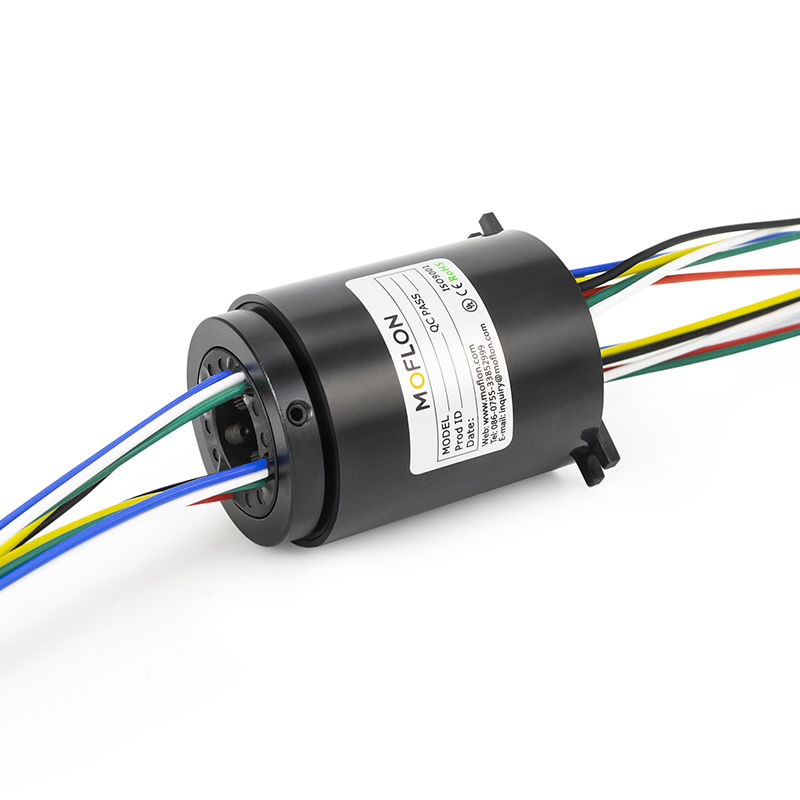
Inside a tunnel boring machine, the cutterhead has to spin without pause while the rest of the machine stays fixed. A slip ring handles that problem by passing electrical power, sensor signals, and control commands across a rotating joint. Instead of using long cables that would twist and snap, it uses a set of conductive rings and brushes that maintain contact as the head turns, letting the motors and instruments receive what they need no matter how many revolutions have passed.
The slip ring sits in a harsh spot, surrounded by dust, water, and constant vibration. Its rings are often plated with materials that resist wear, and the brushes are designed to keep a steady pressure against them even when the ground shakes the whole assembly. Multiple separate circuits are stacked inside, so hydraulic controls, temperature sensors, and guidance systems can all send data and power through the same rotating hub without interfering with one another.
What makes this part so valuable is that a tunnel boring machine never has to stop just to unwind its wiring. The cutterhead can keep grinding forward for long stretches, and the operators still get real-time feedback from the face. That steady flow of power and information is a quiet reason why modern TBMs can work under cities and mountains for months at a time.
The Contact Point That Powers a 500-Ton Crane
In the heart of every heavy-lift operation, the true workhorse isn't always the boom or the counterweight—it's the humble swivel bearing at the base of the crane. On a 500-ton crawler crane, this single contact point carries the full weight of the upper structure while allowing it to rotate a full 360 degrees, often under enormous eccentric loads. Engineers don't call it a 'bearing' in casual chatter; they call it the 'slewing ring,' and it's sized not just for static weight but for the dynamic tipping moments that can occur when the load swings out over the side.
What sets a 500-ton crane's slewing ring apart from smaller machines is the marriage of material and geometry. The raceway is typically forged from a chromium-molybdenum alloy that's been induction hardened to a depth of several millimeters—enough to resist spalling, yet leaving a tough core to absorb shock. The rolling elements, usually cylindrical or tapered rollers, are arranged in multiple rows to handle axial, radial, and moment loading simultaneously. A single crack in this component can sideline the entire crane for weeks, which is why operators watch its grease pattern and torque settings with almost superstitious care.
Maintenance crews often talk about the 'feel' of a healthy slewing ring—the smooth resistance when rotating the house by hand during setup, the absence of a rhythmic thump when the crane works through its arc. One veteran mechanic noted that on a job in the Alberta oil sands, a 500-ton crane's ring lasted 12,000 hours before showing measurable wear, but only because every single bolt was re-tensioned to spec after the first 100 hours of operation, and then checked every 500 hours thereafter. It's that kind of unglamorous attention to a single contact point that keeps a 500-ton giant turning safely, lift after lift.
Why Rotary Indexing Tables Choose Slip Rings Over Wireless
Rotary indexing tables keep assembly lines moving with precise, repeatable stops, but their continuous rotation creates a power and data transfer headache. While wireless options promise clutter-free motion, they stumble when the table must feed sensors, servo motors, and safety interlocks in real time. Slip rings handle this by passing current and signals directly through rotating contacts, so the table never pauses to recharge or resync. No dropped packets, no battery swaps mid-cycle, no latency spikes when the indexer slams into position.
The real advantage shows up in high-speed, high-vibration environments. A rotary table that indexes every 300 milliseconds can't afford a wireless handshake delay or a momentary signal loss from a metal guard interference. Slip rings maintain a hardwired path for encoder feedback, pneumatic valve triggers, and even Ethernet-based I/O, all while spinning 360 degrees continuously. That's why packaging machines, dial assembly stations, and robotic welding cells lean on slip rings even when wireless transmitters would fit the space.
Cost and maintenance also tip the scale. A slip ring rated for millions of revolutions often outlasts several generations of wireless transceivers, and it doesn't need pairing routines, firmware updates, or spectrum clearance in a crowded factory. For OEMs building rotary tables that must run three shifts a day, the choice is practical: slip rings deliver proven, deterministic performance that wireless simply can't guarantee at the same price point.
Salt, Spray, and Still Spinning: Offshore Slip Ring Duty
A slip ring bolted to an offshore crane or wind turbine yaw deck rarely gets a quiet day. The same mist that crusts the handrails finds its way into connector housings, and every rotation drags a fresh layer of brine across the ring grooves. Keeping these units alive means treating the plating not as a luxury but as the first line of defense—gold-on-nickel or silver-graphite stacks are chosen because they shrug off chlorides better than bare copper ever could.
Sealing gets fussy in ways land-based designs never notice. O-rings sized for thermal swell, labyrinth paths that let a little condensation escape without inviting a wave inside, and wipers that pull double duty against dried salt crystals. Even then, the real test happens months later: brushes still have a clean wipe, the resistance hasn't crept up, and the circuit from the rotating mast to the fixed base stays unbroken while the platform heaves.
From Port Cranes to Paper Mills: One Rotating Constant
At first glance, a dockside gantry crane and a paper mill’s drying section share little beyond industrial scale. But swing open an inspection hatch on either and you’ll find the same quiet workhorse: a rotary union feeding hydraulic oil, coolant, or steam into a constantly turning assembly. On the crane, it lets the slewing platform spin through 360 degrees without tangling the lines that power the hoist and grapple. In the mill, it slips steam into the rotating dryer cylinders, keeping them hot enough to flash moisture out of a sheet moving at highway speed.
That single rotating constant—the rotary joint—gets customized for each job, yet the principle doesn’t budge. Crane-side versions shrug off salt spray and shock loads from container drops. Paper-mill variants are machined to hold tight seals under continuous thermal cycling, where a tiny leak means downtime measured in tons of lost production. Swapping one for the other would be absurd, but tracing the design lineage back, it’s the same family of seals, bearings, and passages doing the heavy lifting.
The Unbreakable Link in Continuous Casting Lines
In a continuous casting line, the equipment that truly sets the pace is rarely the most visible unit. It is the connecting hardware between the ladle turret, tundish, and mould that absorbs the harshest punishment. Every joint must endure repeated thermal shock, molten steel splash, and constant mechanical stress without allowing the slightest shift. When one of these links begins to loosen or deform, the entire casting rhythm can falter before anyone notices the source.
The demands on modern connection points go far beyond simple fastening. Take the joint between the mould and its oscillation unit as an example: it has to transmit a precise vibration waveform while holding its stiffness through thousands of thermal cycles. Leading mills now use preloaded locking mechanisms paired with heat-resistant alloys, so that even after months of continuous operation, there is virtually no micro-displacement. This kind of invisible precision is what separates a line that runs smoothly from one that constantly fights alignment issues.
Maintenance thinking has also shifted. Instead of relying on scheduled replacement intervals, more plants are monitoring connection health in real time through temperature drift, displacement sensors, and vibration signatures. The goal is to intervene before a link actually fails, avoiding unplanned downtime that can cost far more than the component itself. A neglected connection point may look insignificant, but it often reveals how well the whole casting operation is truly managed.
FAQ
A substantial slip ring typically combines rugged housing, sealed bearings, and contact materials that resist wear under continuous rotation. It also needs to maintain low electrical noise while coping with dust, moisture, vibration, and wide temperature swings. Real robustness comes from matching the ring's current capacity and signal channels to the actual load profile rather than relying on a generic off-the-shelf unit.
Heavy manufacturing, offshore energy, mining equipment, packaging lines, and wind turbines all depend on slip rings where rotating assemblies must stay powered and communicative. In these settings, a failure isn't just a nuisance; it can shut down a whole production line or turbine, so the slip ring has to be treated as a critical drivetrain component.
They use shielded circuits, precise brush pressure, and sometimes fiber optic rotary joints to prevent data dropouts. The key is minimizing contact resistance fluctuations and separating power channels from sensitive signal paths. For Ethernet, Profibus, or HD video, a well-designed slip ring keeps bit error rates low even at several hundred RPM.
Modular slip rings let engineers add or swap channels without replacing the entire assembly. In industries where machine configurations change often, this means shorter downtime and lower spare parts inventory. It also allows mixing power, analog, digital, and even fluid passages in one compact rotating interface.
Regular inspection of brush wear, cleaning contact surfaces, and checking for dust ingress are essential. Some designs include sealed or purged enclosures that reduce maintenance intervals. It's also wise to monitor temperature and voltage drop trends, since a gradual increase often signals that a contact is degrading before a hard failure occurs.
Yes, if the internal layout separates high-current rings from data rings and uses shielding or coaxial channels. Grounding and cable routing also play a big role. In practice, many robust slip rings carry 3-phase power, 24V control signals, and Gigabit Ethernet through the same rotating joint, but only with careful impedance matching and isolation.
Custom designs can use through-bore, pancake, or capsule form factors to fit around shafts or inside tight housings. Engineers can specify the exact number of rings, current ratings, and connector types. This avoids the compromises of forcing a standard unit into a space it wasn't built for, which often leads to premature connector strain or bearing overload.
Gold-on-gold or silver graphite contacts offer different trade-offs between conductivity, wear rate, and cost. For high-current power, silver graphite handles arcing and heat better, while gold alloys excel for low-current signals. The right material pairing keeps contact resistance stable over millions of revolutions, which directly affects uptime and signal clarity.
Conclusion
Few components carry as much quiet responsibility as a slip ring in heavy industry. Inside a tunnel boring machine, the ring allows power and sensor signals to cross from the static frame into the rotating cutterhead without tangling cables, keeping excavation steady for hours underground. The same principle shows up on a 500-ton crane, where a single contact point must handle high current and control signals while the superstructure swings through endless lift cycles. In continuous casting lines, slip rings bridge the gap between stationary drives and rotating rolls that guide molten steel into solid strand; any interruption there means a costly freeze or line shutdown. These are not convenience add-ons but load-bearing links in the electrical chain.
Rotary indexing tables often reject wireless options because latency and interference are unacceptable when every degree of rotation must match a machining step. A slip ring gives a hardwired, deterministic path for encoder feedback and servo power, so the table stops exactly where it should. Offshore, slip rings face salt spray, high humidity, and constant motion, yet they keep winches, cranes, and radar masts spinning through storms. Port cranes and paper mills may seem worlds apart, but both depend on the same rotating constant: power and data flowing across a moving joint without wear-prone flex cables. Sealing, brush selection, and housing design make the difference between a slip ring that survives a decade of salt air and one that fails in a season.
Contact Us
Contact Person: Xiangpin Li
Email: [email protected]
Tel/WhatsApp: 86 186 1706 8578
Website: https://www.moflon.com