

Leading China RCBO Manufacturer for Reliable Circuit Protection
2026-11-16
When it comes to safeguarding electrical systems, the difference between a minor fault and a catastrophic failure often comes down to one critical component: the RCBO. As a leading China RCBO manufacturer, SINGI has built its reputation on turning split-second protection into an art form. But in a market flooded with circuit breakers that claim reliability, what actually sets a trusted name apart from the rest? This post pulls back the curtain on the engineering choices, real-world testing, and design philosophy that make SINGI the go-to partner for installers and OEMs who refuse to gamble with safety.
Why Every Modern Home Needs a RCBO That Acts in Milliseconds
Electrical faults don’t announce themselves. A frayed cable behind a bookshelf, a faulty appliance, moisture in a socket—these can leak current long before a traditional breaker trips. An RCBO that reacts within milliseconds cuts power at the first sign of residual current, preventing shocks and fires before they escalate. That speed matters because the human heart and modern electronics are equally unforgiving of delay.
Older installations often rely on a single RCD protecting several circuits, so a nuisance trip can plunge the whole house into darkness. A per-circuit RCBO with fast response isolates only the affected area, keeping lights and refrigeration running while eliminating the hazard. For homes packed with sensitive devices—smart thermostats, EV chargers, home offices—a millisecond-level disconnect is not a luxury. It’s the difference between a minor fault and a major loss.
The Overcurrent Scenarios Your Current Breaker Fails to Catch
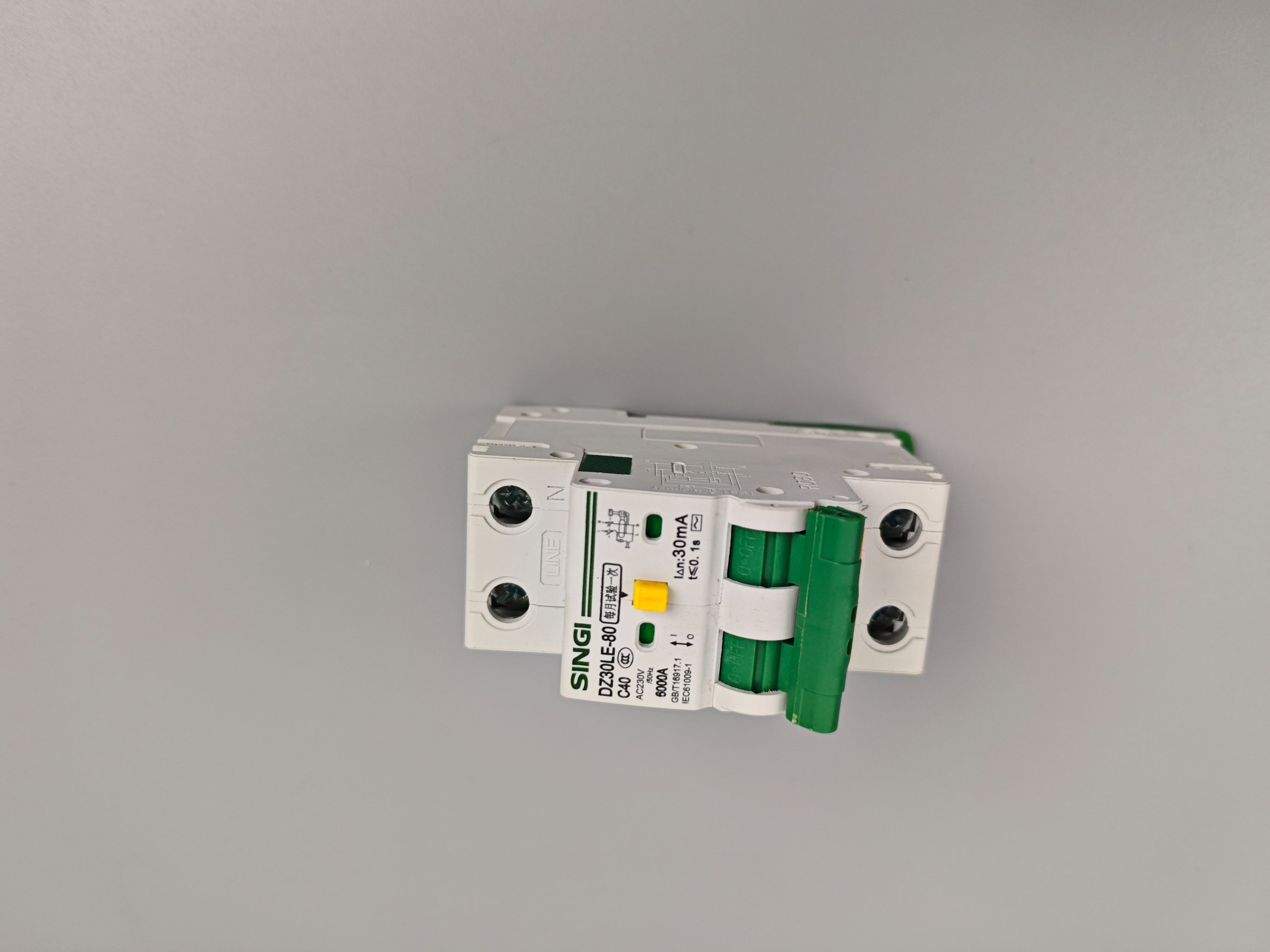
Standard thermal-magnetic breakers respond well to dead shorts and sustained overloads, but they often miss slower, lower-magnitude overcurrent events that still damage wiring and equipment. A classic example is the high-resistance arc fault: the current stays below the instantaneous trip threshold long enough that the bimetal strip never heats to its trip point, yet temperatures at the loose connection can exceed 600°F. Another is the repetitive inrush from capacitor banks or small motors cycling on and off—each surge is too brief to trip the breaker, but the cumulative thermal stress degrades insulation until a real fault develops.
Switching power supplies and variable-frequency drives add another layer: they draw non-sinusoidal currents with high crest factors. The RMS value may remain within the breaker's rating while peak currents repeatedly slam into the magnetic trip zone, causing nuisance trips or, worse, being ignored because the breaker's response curve was never designed for harmonic-heavy loads. Ground-fault currents below the breaker's pickup setting fall into the same blind spot; a phase-to-ground leakage of 5–30 mA won't open a 20 A breaker, but it can electrocute a person or start a fire if the path is through carbonized dust or moisture.
Our Test Lab's Favorite Way to Destroy a Circuit Breaker
We've blown up breakers with staged lightning strikes, cooked them in ovens, and even hit them with a sledgehammer, but the lab's favorite way to destroy one is refreshingly simple: a bolted three-phase fault on a low-impedance source. No fancy waveforms, no exotic transients—just raw, uninterrupted current until something gives.
The test setup is almost embarrassingly basic. We wire the breaker into a bus bar, short the load side with a solid copper link, and close the upstream contactor. The current climbs to tens of thousands of amps in a cycle or two, and the breaker's contacts vaporize before the trip mechanism even gets a chance to think about moving. What's left is usually a scorched shell, a welded trip unit, and a very satisfying bang.
We love this method because it separates honest engineering from marketing claims. A breaker can look great on paper, but a dead short doesn't care about spec sheets. It tests the entire package—contact pressure, arc chute design, bus bracing, and mechanical integrity—all at once. Anything that survives is worth putting on a pole.
What 20 Years of Manufacturing in China Taught Us About Grid Chaos
Two decades inside Chinese factories means learning to treat power cuts not as emergencies but as weather. A textile mill in Zhejiang keeps diesel generators warm and a stack of printed work orders ready to switch lines within minutes when voltage sags. An electronics plant near Shenzhen staggers shifts around the regular evening peak, while a die-casting shop in Dongguan stores compressed air overnight to run pneumatic tools through morning brownouts. The lesson sinks in: grid chaos is not an interruption to production, it is part of the production environment, and the only sane response is to design for it rather than rage against it.
What manufacturers discovered over years of rolling blackouts and sudden frequency drops is that resilience comes from boring redundancy, not heroic fixes. They keep multiple small suppliers for the same component, not because it is cheaper but because one region's grid failure should not stop the line. They install variable frequency drives that tolerate wide voltage swings, and they build local microgrids with rooftop solar plus used EV batteries long before the term became fashionable. The unglamorous habit of buffering everything — inventory, energy, machine capacity — turns out to be the difference between a factory that survives a chaotic grid and one that dies from a single bad afternoon.
Strip away the factory walls and the same logic applies to any system facing unpredictable supply. Grid chaos is rarely a pure engineering failure; it is a mismatch between rigid expectations and fluctuating reality. Chinese manufacturing taught us that flexibility is not a technical feature but a cultural one: you plan for the worst week, not the average day, and you make switching between power sources as routine as changing a cutting tool. The wider grid could learn from this by building in more modular generation, more demand response that actually pays users to back off, and more honest communication about what stability really costs. The factories did not wait for a perfect grid; they built a set of reflexes that let them keep working while the lights blinked.
The Hidden Cost of a Breaker That Trips Too Late
When a breaker takes too long to react, the damage isn't limited to a tripped circuit. Motors keep spinning through voltage sags, insulation cooks quietly inside walls, and loose connections arc long enough to leave carbon scoring. Each event shaves life off wiring and components, and you won't notice until something refuses to start or a faint burning smell appears.
The real expense often lands months after the fault. A compressor that should have been disconnected now needs a rewind. A control board survives a brownout but fails intermittently, triggering callbacks and replacement parts. These are not dramatic failures; they are slow leaks that inflate maintenance budgets and leave systems running at reduced efficiency.
There's also a less obvious operational cost. Facilities tolerate nuisance resets and unexplained lockouts because the breaker eventually opens. Over time, troubleshooting hours pile up, spares are swapped on guesswork, and production pauses become routine. A properly coordinated trip curve would have removed all of this quietly, saving more than the cost of a single breaker replacement.
From Raw Copper to Certified Protection: A No-Corner-Cut Path
Raw copper arrives with mill certificates, but that's just the starting point. We re-melt it under controlled atmosphere to remove oxygen and other impurities, then cast billets that are inspected for internal flaws before any shaping begins. Skipping this step would save time, but the idea of a hidden void in a finished protective component is unacceptable.
After rolling and drawing to the required profile, the copper passes through a multi-stage cleaning and passivation line. Each stage uses fresh chemistry and real-time monitoring; we check surface conductivity and oxide thickness at several points, not just the final reel. That's how we catch drift before it becomes a reject.
Certification isn't a paper at the end—it's a series of destructive and non-destructive tests repeated on every batch: tensile, bend, salt-spray, and dielectric withstand. Only when all results fall within a narrower internal band than the industry standard does the batch get its stamp. That's what we mean by no-corner-cut.
FAQ
We use a refined magnetic trip mechanism paired with a delayed response curve, so brief surges don't cause unnecessary disconnection. The residual current detection is tuned to ignore transient leakage below 30mA, which keeps circuits stable without compromising safety.
Every unit passes a 100% functional test on automated stations, including a 1,000-cycle endurance check and a thermal imaging scan for hotspots. We also pull random samples for salt spray and vibration tests to catch issues that only show up in harsh installations.
Yes, we regularly adjust B, C, and D curves and can build ratings from 6A up to 63A with custom pole configurations. Our engineering team works from your load profile to match inrush requirements, and prototypes are usually ready within two weeks.
Look for IEC 61009-1 compliance plus regional marks like CE, UKCA, or CB scheme certificates. Our RCBOs hold current CB test certificates and are approved for EU and UK markets, with documentation available for customs clearance.
We run a closed-loop process where each batch is traceable to raw material lots and production line shifts. Inline automated optical inspection checks solder joints and component placement, and any drift triggers a line stoppage until the root cause is fixed.
Standard lead time is 25 to 35 days for container quantities, but we hold buffer stock for popular 30mA and 100mA models, which can ship within a week. For urgent orders, we can reserve production slots with a small deposit.
We help with selection, derating calculations, and wiring diagrams for tricky distribution boards. Our engineers also review your panel layout to ensure proper ventilation and busbar alignment, which reduces field failures.
Conclusion
Modern homes run on electronics that demand protection far beyond what a standard breaker offers. A residual current circuit breaker with overcurrent protection that reacts within milliseconds isn't a luxury—it's the difference between a flicker and a fire. We've spent two decades in Chinese manufacturing watching grids swing from brownouts to spikes, and that chaos taught us exactly where cheaper breakers fail. They miss the slow, creeping overcurrents that cook wiring inside walls, the subtle earth leakage that never trips a thermal-magnetic curve, and the surge that arrives with a lightning strike two streets away. Our test lab has a favorite way to destroy a circuit breaker: feed it the exact fault profile it was never designed to catch. Time after time, the breaker that trips "eventually" is the one that lets a small problem become a catastrophic one.
The hidden cost of a late trip isn't just the repair bill—it's the equipment that dies before the breaker reacts, the production line that halts, the family left unprotected overnight. That's why our path from raw copper to certified protection skips no corners. Every coil is wound to handle real grid chaos, not just laboratory ideals. Every contact is tested against overcurrent scenarios that standard certification never asks about. A reliable RCBO should act before you even notice a fault, because by the time you see smoke, the breaker has already failed its only job. That's what twenty years on the factory floor taught us, and it's what we build into every unit that leaves our line.
Contact Us
Contact Person: Jack
Email: [email protected]
Tel/WhatsApp: (+86) 13757759651
Website: https://www.singi.com