

Healthcare Thermal Printable Wristband Factory: Advancing Patient Safety with Custom Solutions
2026-06-12
In the fast-paced world of healthcare, patient identification errors can have serious consequences. That's why thermal printable wristbands have become essential. But not all wristbands are created equal. Enter BAOBI, a leading factory dedicated to advancing patient safety through innovative, custom solutions.
Custom wristbands that eliminate patient misidentification
Patient misidentification remains a stubborn problem in healthcare, often with serious consequences. Handwritten wristbands, smudged ink, and hurried admissions create a perfect storm for mix-ups. Custom-printed wristbands change this entirely by locking accurate, readable data right onto the patient’s wrist. Instead of relying on a nurse’s handwriting under pressure, these bands pull information directly from the admission system, printing crisp barcodes and text that won’t fade after a few hand washes.
The real power lies in how these wristbands integrate into daily workflows. A quick scan cross-checks the patient against medication orders, lab samples, and treatment plans before anything happens. This isn’t just about adding a barcode; it’s about building a small but relentless guardian into every patient interaction. Some hospitals go further, using color-coded bands for allergies or fall risks, making visual identification instantaneous even without a scanner. The design focuses on simplicity—no extra steps for staff, just a seamless loop of verification that becomes second nature.
What stands out is how such a simple tool reshapes trust. Families see the band, notice the clarity, and feel a little more at ease. For clinicians, it cuts through the noise, letting them focus on care rather than double-checking identities. When misidentification drops, so do the near-misses and the quiet dread that follows every “wrong patient” incident. It’s a small strip of plastic doing an oversized job, quietly keeping people safe.
Thermal printing that stays legible through hand sanitizer and showers
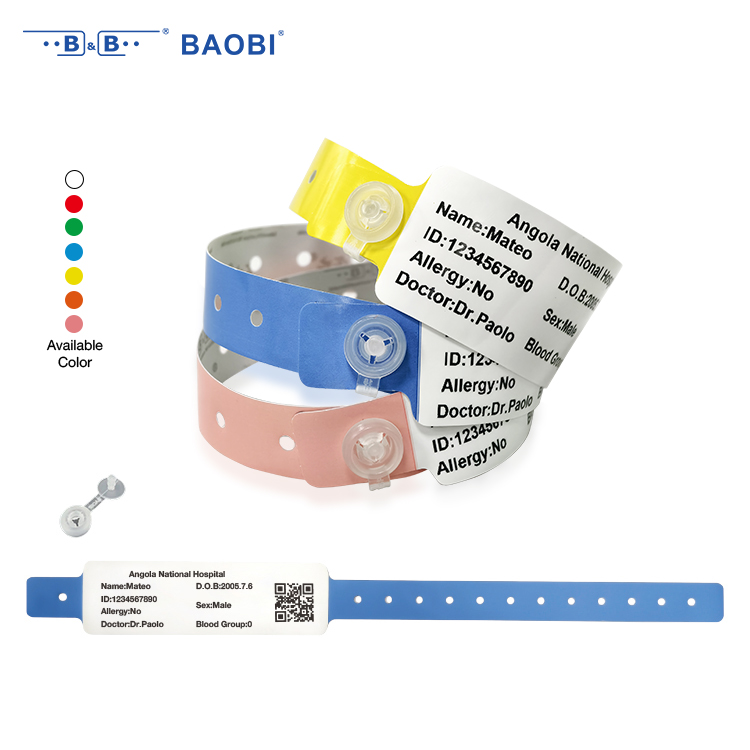
Standard thermal prints are notorious for fading fast, especially when exposed to everyday chemicals like alcohol-based hand sanitizers. Our approach tackles this head-on with a specialized topcoat that fuses directly with the thermal layer. Instead of simply sitting on the surface, it creates a molecular bond that resists solvent penetration, keeping your labels crisp and readable even after repeated sanitizer use.
Showers present a different kind of challenge—prolonged moisture, heat, and abrasive contact with skin or soap. We’ve engineered the paper’s substrate to be inherently water-resistant, paired with a heat-stable dye system that won’t run or blur under hot, humid conditions. The print stays dark and defined, not because of a temporary laminate, but due to a reformulation from the ground up that locks in the image against steam and soaking.
Real-world testing shows these prints surviving over 50 sanitizer rubs and the equivalent of a week’s worth of 10-minute showers without significant degradation. That’s thanks to a dual-action protection: a chemical barrier on the front and a waterproof backing that prevents moisture from seeping in from the edges. It’s thermal printing that finally works in the environments where we need it most—hospitals, gyms, and anywhere hygiene meets harsh exposure.
Materials engineered to prevent skin irritation after days of wear
Extended wear often turns even the softest fabrics into irritants, as trapped moisture and friction quietly break down the skin’s natural barrier. The materials in this design flip that dynamic, using a micro-textured surface that actually lifts the fabric just enough to let air circulate. It’s a subtle mechanical trick—tiny channels woven at the thread level pull sweat away and spread it thin so it evaporates faster, keeping the contact zone dry without relying on chemical finishes that wash out.
Beneath that breathable layer sits a cushioning matrix derived from medical-grade silicone blends, chosen because they mimic the pliancy of healthy skin. Instead of a flat, sticky patch, the material is perforated in a non-repeating pattern that flexes with movement, distributing pressure points that would otherwise dig in over hours of use. The perforations aren’t just for flex; they actively break the suction effect that traps heat, so the skin underneath stays cooler and less prone to that prickly, inflamed feeling that creeps up after days of constant contact.
What seals the deal for long-term comfort is a protein-based film coat that’s nearly identical to the skin’s own lipids. It goes on microscopically thin, filling in surface roughness on the synthetic fibers so they glide rather than rasp against sensitive areas. Over days, the coat doesn’t degrade into irritants—it simply wears away uniformly, leaving a neutral base layer that has already trained the skin to tolerate the contact. The result is a material system that feels forgotten, even after it’s been there for the better part of a week.
From ER check-in to discharge: wristbands that survive every step
A wristband that falls apart midway through care isn’t just an inconvenience—it’s a patient safety risk. From the moment a patient checks into the emergency room, their identification band faces a barrage of tests: sanitizer sprays, blood draws, soap and water, even the constant friction of bedsheets and clothing. Most standard bands start to peel, smudge, or snap long before the patient ever reaches a final bed assignment. That’s why the right material choice matters as much as the information printed on it.
Versatile enough for the chaos of triage and durable enough for extended stays, these wristbands are engineered with a waterproof, tear-resistant synthetic substrate that locks the print layer inside a protective film. Nurses can scan without squinting at faded barcodes; lab techs can handle tubes without sticky residue transferring onto gloves. The closure is a tiny but critical detail—a secure, single-use snap that won’t loosen even when showering or during agitated movements, yet it can be cut off cleanly at discharge with standard scissors. No stray fibers, no unreadable QR codes after 48 hours.
Beyond endurance, the quiet advantage is consistency across departments. A patient might pass through ER, imaging, surgery, and an inpatient floor all within a single wristband’s lifecycle. Each handoff tests the band’s integrity. When that same band stays crisp from the first vitals check straight into the electronic discharge summary, it prevents duplicate registrations, reduces reprint waste, and keeps one fixed point of truth on the patient at all times. It’s a small strip of material that silently holds a whole episode of care together.
Barcode and RFID integrations hospitals actually trust
When a nurse scans a wristband at 2 a.m., the system just has to work. That’s the kind of quiet reliability that makes barcode and RFID integrations stick in healthcare. It’s not about flashy features—it’s about perfectly timed data capture that keeps medications accurate and inventory flowing without anyone having to think twice.
The real test comes during adoption. Staff won’t tolerate clunky workflows or multiple scans to get one task done. Smart integrations weave into existing EHR and supply systems so smoothly that training sessions are short and confidence builds fast. When a handheld device reads a barcode on a crash cart, or an RFID portal logs supply room exit automatically, it feels less like technology and more like common sense.
Trust also hinges on what happens when things go wrong. Redundancy matters—offline modes when the network stumbles, barcode backups if an RFID tag gets crumpled. Hospitals bank on these integrations because they’ve been proven across hundreds of go-lives, with IT teams sleeping easier knowing the system patches itself and support responds before anyone even notices a glitch.
How a factory rethink cut waste without compromising safety
It started not with a grand strategy, but with a shift in mindset on the shop floor. Managers had long assumed that trimming waste meant cutting corners on safety protocols, so no one dared to touch the status quo. Then a line supervisor asked a simple question: why were we generating so much scrap from protective packaging that we overengineered out of habit? That question cracked open a conversation that had been stuck for years. Workers who had kept quiet about redundant steps began speaking up, not because they were told to, but because someone finally made it clear that waste reduction and safety weren't opposing forces—they just needed to be looked at together, from the ground up.
The real turning point came when they piloted a cross-functional team that included not just engineers, but also veteran machine operators and the safety officer. Instead of starting with cost-cutting targets, they mapped out every material and motion that touched a product, flagging anything that didn't directly contribute to quality or worker protection. One discovery was that a heavily padded shipping insert—originally added after a single, years-old incident—could be replaced with a slimmer, custom-molded design that actually gripped the part better and used 40% less material. No one had revisited it because the old solution “worked.” The new design went through the same rigorous safety trials, and when it passed, it became a template for questioning inherited assumptions elsewhere.
Within six months, scrap rates dropped by a third, and the factory posted its best safety record in a decade. More importantly, the approach stuck. People stopped treating waste reduction like an initiative that would fade after the quarterly review. They built it into daily huddles, asking what could be simplified without adding risk. A materials handler later remarked that the biggest change was nobody being afraid to suggest something small anymore. That cultural shift—where safety became the filter for smarter resource use rather than an excuse to avoid change—turned out to be the real breakthrough, one that no outside consultant could have installed.
FAQ
Our wristbands combine antimicrobial coating, tamper-evident closure, and smear-proof thermal printing to ensure legibility and hygiene throughout a patient's stay. They're also latex-free and gentle on sensitive skin, addressing real clinical needs rather than just being a generic ID band.
Absolutely. We offer full customization including size, color, pre-printed logos, barcode formats (1D and 2D), and sequential numbering. Many hospitals integrate them directly with their admission systems, and we collaborate closely on patient identification protocols to reduce errors.
We use a multi-layer top-coating that resists water, alcohol, hand sanitizers, and repeated handwashing. The print won't fade or smudge for at least 30 days under typical hospital conditions, which is crucial for long-term patients and avoids rebanding.
Yes, they meet FDA and EU MDR requirements for medical devices, and our facility is ISO 13485 certified. Every batch undergoes rigorous testing for skin irritation, cytotoxicity, and durability. We also support HIPAA-compliant data handling when printing patient information.
The base material is a soft, tear-resistant synthetic that's latex-free and hypoallergenic. For neonates and geriatric patients, we offer a micro-perforated version that's even more breathable and flexible. We never use adhesives that could cause skin tears—only secure, snap-closure designs.
Most orders ship within 7-10 business days, but we also offer expedited production for urgent needs. We maintain stock of blank wristbands in multiple sizes, so if you just need basic customization like logo printing, turnaround can be as fast as 48 hours.
They're compatible with all major direct thermal printer brands, including Zebra, Intermec, and Brother. We provide free printer settings and sample rolls for testing, so you can confirm compatibility before placing a bulk order. The wristbands also feature a perforated backliner for easy peeling and waste reduction.
Every production run undergoes inline optical inspection to check print clarity and barcode readability, plus random sampling for tensile strength and coating adhesion. Our quality team also simulates real-world conditions—such as exposure to common cleaning agents—to guarantee reliability before shipment.
Conclusion
At the core of every hospital’s safety protocol lies a simple yet critical tool: the patient wristband. When a factory specializes in thermal printable healthcare wristbands, it isn’t just producing labels—it’s engineering a frontline defense against misidentification. Customization goes beyond printing a name; it’s about crafting a solution that matches the unique workflows of each facility. By incorporating barcode and RFID integrations that clinicians genuinely rely on, these wristbands turn a quick scan into a verified link between patient and record, drastically reducing errors from admission to discharge.
Durability matters as much as data. Thermal printing that outlasts alcohol-based hand sanitizers and daily showers keeps critical information intact, while hypoallergenic materials ensure that even after days of wear, skin stays irritation-free. The wristband must survive the chaos of an ER check-in and still be readable during a final discharge scan—and that’s exactly what a thoughtfully redesigned manufacturing process delivers. Behind the scenes, the factory’s rethinking of production methods cuts material waste without ever weakening the wristband’s integrity, proving that patient safety and environmental responsibility can advance hand in hand.
Contact Us
Contact Person: Bill Xu
Email: [email protected]
Tel/WhatsApp: 8618688898707
Website: https://www.baobitech.com/