

Digital Manifold Manufacturer Selection Guide for Reliable Performance
2026-11-16
You can’t afford a digital manifold that drifts under pressure. Yet sorting through manufacturer spec sheets often feels like decoding a foreign language. This selection guide strips away the marketing fluff and focuses on what drives dependable field performance. Along the way, you’ll see why HONGSEN keeps surfacing as a go-to for technicians who value accuracy and longevity—and why that matters for your next job.
Why Digital Manifold Accuracy Claims Often Fall Short
Lab bench numbers look impressive, but a digital manifold bolted to a vibrating compressor on a hot rooftop deals with conditions the spec sheet never mentions. Temperature swings of 30 degrees between morning shade and afternoon sun can shift the internal reference voltage enough to move a pressure reading by a tenth of a bar or more. Electromagnetic noise from contactors, inverters, or nearby radio gear sneaks into unshielded sensor wiring, and suddenly the “±0.5% full scale” promise evaporates into a flickering number that no technician would trust for a critical charge.
Then there's the slow creep of sensor aging. Most digital manifolds ship with a factory calibration done months before the unit ever reaches a toolbox, and that calibration assumes a fresh transducer with predictable output. Real use involves oil mist, moisture intrusion around fittings, and hundreds of thermal cycles that gradually warp the sensing element. The built-in zeroing function helps with offset, but span error—where the reading drifts more at high pressure than low—goes unnoticed because nobody sends a manifold back for recalibration every season. By year two, a claimed 0.25% accuracy can quietly become 2% or worse, and the display still looks just as confident.
Software tricks also mask the truth. A digital manifold converts pressure to saturated temperature using stored refrigerant property curves, assuming pure refrigerant and no non-condensables in the system. In the field, recovered R-410A might carry a few percent of air or mixed lubricant that shifts the pressure-temperature relationship. The manifold calculates a subcooling value to the decimal point, but that precision is built on a fiction of ideal gas behavior. Technicians often discover this only when two different brands of digital manifolds disagree by several degrees on the same port—each one precisely wrong in its own way.
Calibration Drift as a Window Into Component Quality
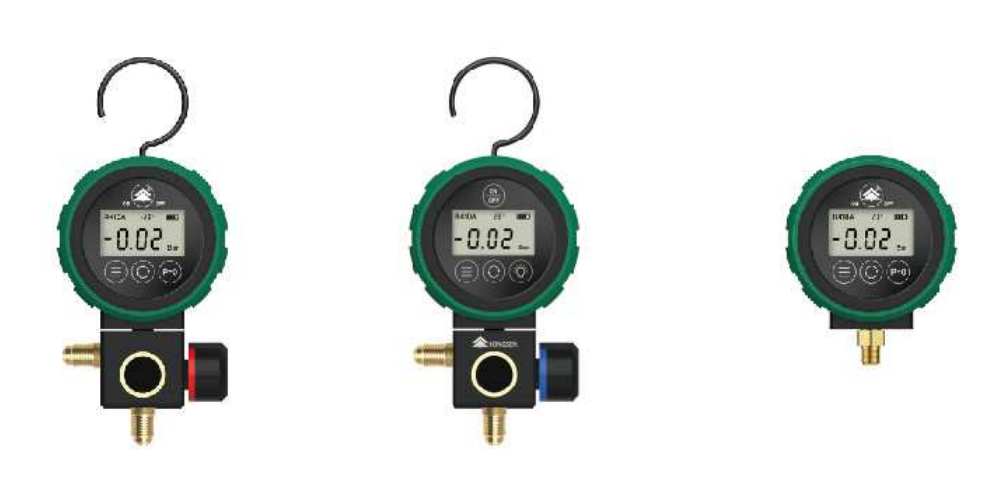
Every sensor, actuator, and analog front-end carries a fingerprint of its own imperfections. Calibration drift—the slow movement of a component's output away from its original tuned state—offers a surprisingly direct read on the underlying quality of that component. When drift rates stay low and predictable across temperature swings and aging cycles, it usually means the manufacturer controlled material purity, thermal compensation, and packaging stress with real discipline. Cheap parts tend to drift fast and inconsistently, forcing frequent recalibration or even field failures that no amount of software correction can fully hide.
Engineers who ignore drift data are essentially flying blind on supplier quality. By tracking how calibration coefficients shift over weeks or months, you can separate components that merely pass a one-time spec from those that hold their performance over a real service life. High-quality references, precision resistors, and stable oscillators all show drift curves that flatten out after initial burn-in, while marginal parts keep wandering in a way that correlates with moisture ingress, die stress, or weak passivation. That signal is hard to fake in a datasheet.
Treating drift as a diagnostic rather than an annoyance changes how teams approach qualification. Instead of waiting for field returns, they use accelerated aging and periodic calibration logs to grade component lots, adjust preventive maintenance intervals, and push back on vendors whose parts look good on day one but degrade too fast. The drift signature becomes a practical window into the quality culture behind the component—because stable output over time is one of the hardest things to achieve in electronics, and it almost never happens by accident.
Materials That Survive Vibration and Temperature Swings
Designing components for environments that combine constant mechanical shaking with rapid thermal shifts demands more than just picking a tough alloy. The real problem lies in how these two stressors interact: vibration can accelerate crack growth at points where thermal expansion has already created micro-stresses, while sharp temperature changes can alter a material's damping capacity and stiffness, turning a previously stable structure into one that resonates dangerously. Engineers often discover that a material which performs well under vibration alone or thermal cycling alone fails quickly when both are present, because the failure mechanisms feed into each other.
A practical route forward involves selecting materials with inherently high internal friction to dissipate vibrational energy as heat, combined with a low coefficient of thermal expansion to minimize dimensional changes. Austenitic stainless steels, certain nickel-based superalloys, and specially treated titanium grades have proven effective, but the exact choice hinges on the temperature range and amplitude of the vibration. For extreme cases, composites with tailored fiber orientations or metal matrix composites can offer a better trade-off between stiffness, damping, and thermal stability, though they come with higher manufacturing costs and more complex joining requirements.
Beyond material selection, surface treatments and structural design play an equally critical role. Shot peening, laser shock peening, or thin compliant layers can introduce compressive residual stresses that blunt crack initiation from combined cyclic loading. Adding constrained-layer damping treatments or designing in deliberate mass discontinuities can shift natural frequencies away from operating ranges while also accommodating thermal growth. The most reliable solutions rarely come from a single super-material, but from a carefully matched system of base material, surface engineering, and geometry that accounts for the worst-case combination of vibration and temperature swings over the component's lifetime.
How Failure Rate Transparency Separates Manufacturers
In component sourcing, the quiet differences between suppliers rarely show up on a spec sheet. One maker might publish quarterly field failure data down to the batch level, while another offers only a generic warranty number. That gap becomes obvious the first time a production line stops. Buyers who have lived through a recall or a wave of early-life failures learn to treat transparent failure reporting as a leading indicator of engineering discipline, not just a nice-to-have.
Failure rate visibility also changes how problems get solved. When a manufacturer shares failure modes with root cause summaries, their own teams are usually held to a different internal standard. Problems surface faster, get prioritized differently, and rarely get hidden behind "no fault found" claims. Suppliers that resist this level of openness often end up spending more energy managing customer perception than improving the actual hardware, and that pattern tends to repeat across product generations.
Over time, this distinction reshapes vendor relationships. Engineers start routing new designs toward suppliers that have demonstrated a willingness to expose their failure data, even when the numbers aren’t perfect. It’s not about having zero defects—that’s unrealistic. It’s about whether the manufacturer treats failure information as a shared operational asset or as a liability to be controlled. That choice signals more about long-term reliability than any datasheet ever will.
Custom Port Configurations Without Project Delays
When a project timeline is tight, port configuration often becomes a bottleneck that nobody plans for. Instead of waiting on standard templates or manual firewall approvals, teams can pre-define custom port rules that match the exact needs of each service. This approach keeps deployments moving while maintaining strict network boundaries, because every port is mapped to a specific application path rather than opened broadly.
A practical way to avoid delays is to treat port configuration as a version-controlled artifact. Each change is reviewed in the same pull request as the code that needs it, so security and infrastructure teams can see exactly which service uses which port and why. This removes the back-and-forth emails that often stall releases, letting developers self-serve within guardrails that are already approved.
The result is a smoother handoff between development and production. Custom ports don't have to mean custom risk—when the mapping is explicit and automated, the network layer adapts to the application instead of forcing the application to fit a generic network setup. That's how teams ship faster without cutting corners on security or compliance.
Support Patterns That Predict Long-Term Reliability
Long-term reliability rarely shows up as a single dramatic failure; it emerges from the quiet repetition of support interactions. Teams that log every customer contact—not just solved tickets but also near-misses and workarounds—begin to see patterns that separate durable products from fragile ones. A support queue that consistently surfaces the same three installation issues month after month is not just a workload problem; it’s a signal that the product’s onboarding path has a structural flaw. In contrast, when support volume drops after a feature update and stays low, that’s evidence the underlying design improved rather than just the documentation.
Another predictive pattern is the ratio between first-contact resolutions and escalating tickets. High first-contact resolution for routine problems suggests clear error messages, intuitive recovery paths, and well-trained staff. But if the escalation rate climbs for a specific component, it often precedes a drop in field reliability six to nine months later. Mature support teams track these trends by module, not just by product line, and they share that data with engineering before customers start demanding refunds.
Finally, the way support handles recurring defects matters more than the defects themselves. Teams that publish temporary fixes but never convert them into permanent code changes create a reliability debt that compounds silently. The most durable products come from companies where support tickets are treated as unfinished design work, not as interruptions. When a workaround becomes a standard operating procedure, it’s usually a sign that the product’s long-term reliability is already compromised.
FAQ
Look beyond the spec sheet. Verify the actual sensor accuracy across the stated temperature range, ask for long-term drift data, and check whether the manifold body uses corrosion-resistant fittings. A manufacturer that openly shares calibration records is usually a safer bet than one that only highlights a low price.
Seals and internal sensors degrade quickly if they are not matched to the refrigerants and pressure spikes you encounter daily. Choose a manifold rated well above your maximum working pressure and confirm that all wetted materials are compatible with the refrigerants and oils in your service work, otherwise small leaks or false readings will appear within months.
A display can show three decimal places while the sensor drifts badly at high or low ambient temperatures. Reliable performance comes from a temperature-compensated sensor that holds its accuracy across the full working range. Ask for accuracy specifications like ±0.5% of full scale over -10°C to 50°C, not just room-temperature numbers.
Look for an IP54 or higher rating, a shock-absorbing boot or reinforced housing, and metal hose fittings instead of cheap plastic. The screen should be readable in direct sunlight and the buttons should not feel loose. These details matter more in daily van life than any marketing phrase about durability.
Those marks confirm basic safety and regulatory compliance, but they do not prove the manifold will stay accurate after two years of daily use. Dig deeper by requesting third-party calibration certificates, real customer case studies, and the manufacturer’s internal endurance test procedure. A reliable maker will share this without hesitation.
Send a pre-sales email asking about calibration turnaround time, spare sensor availability, firmware update policy, and warranty coverage for the display and pressure transducers. If the reply is vague, slow, or pushes you to buy first, expect the same attitude when your tool fails mid-season.
Request clear answers on minimum order quantity, lead time, whether custom pressure ranges affect calibration stability, and if they can pre-install your preferred refrigerant profiles. A good manufacturer will tell you which customizations are safe and which ones compromise accuracy, rather than agreeing to everything just to close a sale.
Conclusion
Choosing a digital manifold manufacturer often starts with datasheet accuracy numbers, but those claims rarely hold up in the field. Real insight comes from examining calibration drift over time—stable readings under repeated cycling point to better internal components like sensors and valve seats. Equally critical are the materials: brass bodies with stainless steel internals or reinforced polymer housings withstand constant vibration and temperature swings far better than cheap alloys. A reliable manifold isn't just precise on day one; it stays consistent after months of rough handling and thermal stress.
Transparency about failure rates sets serious manufacturers apart from those hiding behind vague reliability slogans. Ask for documented MTBF or field return data, not just marketing promises. Then look at how they handle custom port configurations—the best suppliers offer modular blocks or rapid machining without dragging your project into endless lead times. Finally, examine their support habits: proactive firmware updates, accessible calibration services, and engineers who actually answer technical questions. These patterns, far more than glossy brochures, predict whether a manifold will keep your system running for years without surprise downtime.
Contact Us
Contact Person: KOPASS HO
Email: [email protected]
Tel/WhatsApp: 8613606566112
Website: https://www.hongsenref.com/