

China UHT Sterilizer Supplier Selection Criteria for Dairy Processors
2026-08-16
Selecting the right UHT sterilizer supplier in China can feel like navigating a minefield for dairy processors—equipment quality, after-sales support, and regulatory compliance all hang in the balance. Yet too many decision-makers still settle for surface-level comparisons. What if the key differentiators were hiding in plain sight? From thermal efficiency curves to CIP system integration, this guide unpacks the criteria that truly matter. Along the way, we’ll spotlight how INTOP Machinery approaches these challenges, offering a practical framework to avoid costly missteps before you sign the contract.
UHT Thermal Profiling on Whole Milk and Cream
Raw temperature traces from UHT runs on whole milk and cream rarely sit flat, even when the set point looks stable. Whole milk tends to show a rapid come-up and a slightly uneven hold because protein and mineral deposits begin to form on hot surfaces within minutes. Cream responds differently: the higher fat fraction damps short-term temperature swings near the heating wall, but once the product reaches the holding tube, its slower internal mixing can leave a wider spread between the fastest and slowest particles.
A practical thermal profile has to track not just the holding temperature but the pressure and velocity shifts that accompany each product switch. With whole milk, the main concern is fouling in the downstream section of the indirect heater, which gradually pushes the product temperature above the nominal set point if left uncorrected. Cream often requires a slightly lower final heating intensity or a shorter hold because the fat phase carries much of the heat load and can develop cooked or oxidized notes before the water phase reaches the same lethal effect. Swapping the order of homogenization also changes the measured profile, since upstream homogenization in cream reduces fat globule size and gives a more uniform heat uptake.
Operators who rely only on the recorder chart may miss the real differences between milk and cream. A better approach is to log the cold-point lag right after the heating section and the cooling curve after the vacuum chamber. Whole milk usually shows a sharper cooling response, while cream holds heat longer and may need a slightly higher back pressure to prevent localized boiling in the flash cooler. These small shifts in the profile explain why a line optimized for milk often drifts out of spec when cream is run without adjusting the hold time, homogenizer position, or cooling water flow.
Hygienic Weld and Finish Checks Before Signing
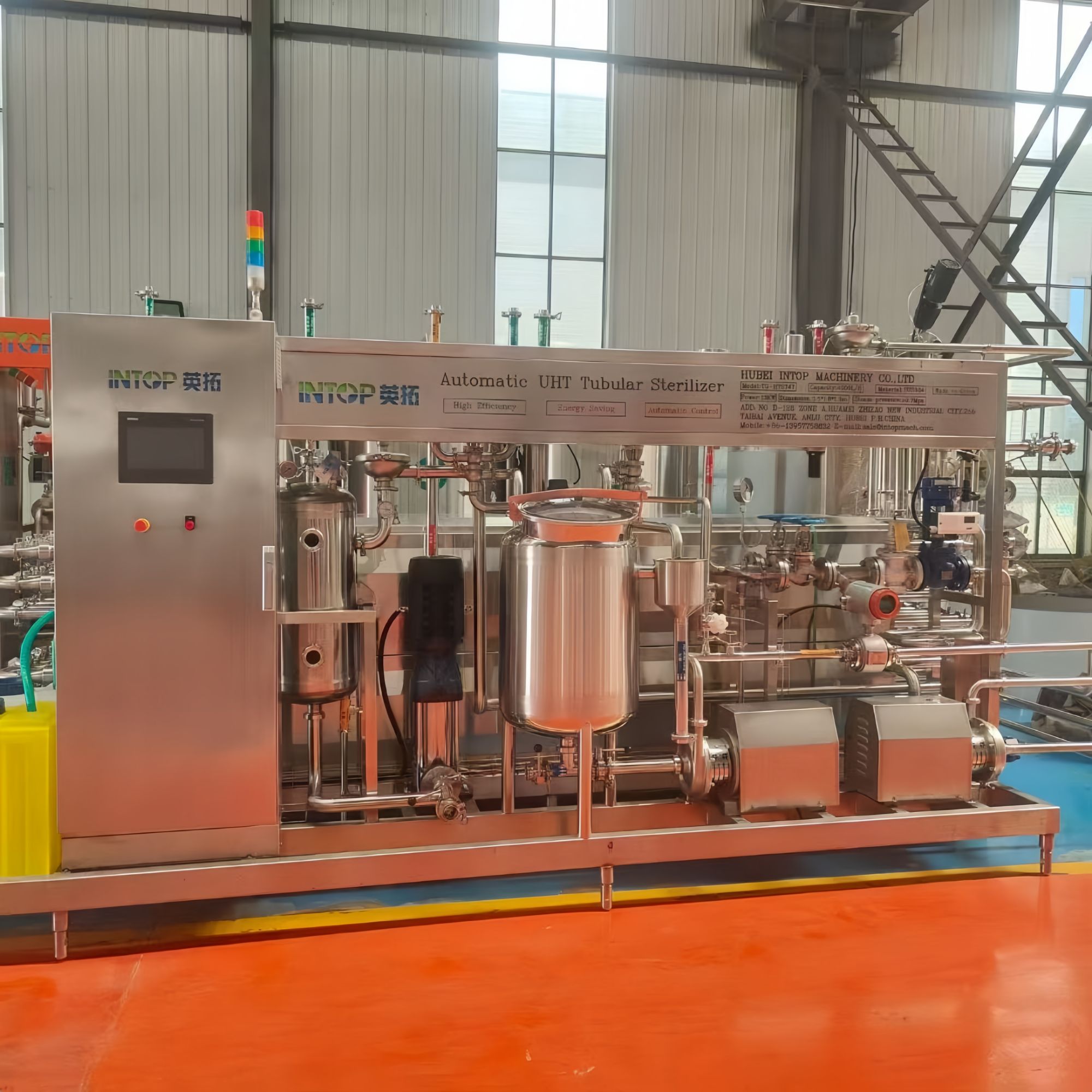
In sanitary piping systems, every weld and finished surface tells a story about how the line will behave under production conditions. Before any acceptance document gets signed, inspectors look beyond a simple visual pass. They run fingers along the inside of crevice-free joints, check for discoloration bands that hint at excessive heat input, and verify that purge gas actually reached the root side. Small shadows, pinholes, or a slight mismatch at the joint can become harborage points for bacteria once product starts flowing.
Surface roughness gets measured with a profilometer, not just judged by eye. For most hygienic services, an Ra of 0.8 µm or finer on product-contact surfaces is expected, but the real challenge is consistency across the weld zone and adjacent heat-affected area. Any grinding or polishing marks should run parallel to flow direction, and blue or brown oxide layers are never acceptable because they signal chromium depletion and reduced corrosion resistance. Check that all fittings, ferrules, and tubing ends are free from scratches, embedded grit, and tool marks that could trap cleaning chemicals or product residue.
Finally, compare the weld map against the actual installation before signing off. Confirm that each joint has a corresponding weld log with date, welder identification, material heat numbers, and purge method. If any field repair was made, request the re-inspection report and verify that the repaired area meets the same finish criteria as the original work. Only when these checks align—no open deviations, no unrecorded field welds, no rough surfaces—should the acceptance signature be applied.
Mapping Chinese Certifications to Your Export Dairy Market
Entering China’s dairy market means working with a certification stack that rarely behaves like a single checklist. The first layer is CNCA registration for overseas dairy processing facilities—without it, customs clearance stalls before any product standard is even considered. But mapping goes deeper: each product category carries its own GB code, and an infant formula shipment will face stricter residue and labeling requirements than UHT milk. Local CIQ offices sometimes request supplementary certificates from the country of origin, especially for organic or specialty claims, even when the national framework doesn’t list them.
A practical mapping exercise starts by pairing every certificate you already hold—HACCP, ISO 22000, organic, halal, or any regional quality mark—with the exact Chinese requirement it satisfies or fails to satisfy. Many exporters assume ISO 22000 will impress a buyer, but Chinese importers tend to care more about GB compliance and the CIQ inspection record. One useful approach is to build a living matrix that links each certificate’s issuing body, scope, and expiry date to the relevant Chinese regulation, then update it every time CNCA or SAMR publishes a change. This reveals gaps that a generic compliance audit misses, like the need for a separate Chinese label approval or a provincial add-on for cheese imports.
Testing Spare Parts Turnaround from Chinese Hubs
Every spare part that leaves a Chinese hub carries a hidden question: how fast can it be verified, cleared, and pushed back into the supply chain? The real test isn't just the clock on the wall—it's the friction between warehouse handoffs, local courier pickup windows, and the unpredictable rhythm of export documentation. A part might sit for six hours waiting on a test bench that's already booked, or it might sail through in forty minutes because the right paperwork landed on the right desk at the right moment.
What often gets overlooked is the human layer. The engineer who runs the bench test has a queue, and that queue doesn't care about your SLA. The freight forwarder's driver has a route with fifteen stops, and yours is number nine. Turnaround from hubs like Shenzhen or Chengdu isn't a linear process—it's a series of small delays stitched together, and the only way to shorten it is to know which stitch tends to break first.
Pilot runs matter more than dashboards. Sending five identical spares through the same hub on different days often yields five different stories. One gets flagged for random inspection, another sits over a weekend because the receiving lab works Monday to Friday, a third gets a same-day bench slot because a production line just went down and someone escalated it. That variance is the real benchmark. Anyone can quote a median turnaround; the useful number is the spread between the fastest and slowest path, and whether your own parts consistently land in the middle or the tail.
Energy and Maintenance Costs over a Ten-Year Run
When you stretch the timeline to a full decade, the real story isn't the sticker price—it's what quietly drains your budget every single month. Energy consumption and upkeep tend to follow a predictable curve: early years feel almost effortless, but by year five or six, small inefficiencies start compounding. A system that sips power today might gulp it tomorrow, especially if filters clog, seals degrade, or sensors drift out of calibration. The smart move is to look beyond rated efficiency and ask how the equipment behaves when nobody's watching.
Maintenance costs rarely arrive as one big bill. They trickle in through routine servicing, unexpected part replacements, and the occasional emergency call-out that always seems to happen on a holiday weekend. Over ten years, labor rates rise, parts become harder to source, and older units often demand more frequent attention just to hold their baseline performance. Comparing options on day one is misleading unless you factor in how availability of spare parts and the local technician network will look in year eight or nine.
There's also a hidden layer: the cost of downtime. Every hour a unit sits offline translates into lost productivity, spoiled inventory, or uncomfortable occupants—expenses that never show up on a standard energy audit. A slightly pricier upfront choice with a track record of reliable, low-maintenance operation can easily pay for itself by the halfway mark. When planning for a decade, the winners are rarely the cheapest to install; they're the ones that keep their energy appetite modest and their service visits short, few, and drama-free.
Walking the Production Floor to Spot Hidden Engineering Gaps
Most design flaws don't announce themselves. They hide in the way a technician reaches past a guard to reset a sensor, or in the hesitation of an operator who has learned to work around a poorly placed control panel. Walking the production floor with no agenda other than observation lets these quiet failures surface. You hear the rhythm of the line, see where people pause, improvise, or avoid certain stations altogether. That pause is data. It usually points to an engineering assumption that didn't survive contact with reality.
Talking to operators without a clipboard changes the conversation. Instead of asking if everything is fine, watch them run a cycle and then ask what they would change if they didn't have to worry about cost or management approval. The answers often reveal gaps between the CAD model and the actual workflow: a fixture that blocks a light curtain, a sequence that forces two-handed operation in a one-handed zone, or a maintenance access point that no one can reach without shutting down half the line. These are not complaints. They are unvarnished field data.
The trick is to resist solving anything on the spot. Note the problem, trace it backward to the design choice that created it, and then ask a different question: what would the line look like if that constraint never existed? That mental exercise often uncovers a simpler architecture, a relocated sensor, or a revised work instruction that eliminates the workaround entirely. The hidden gaps are rarely expensive to close. They are just invisible from behind a desk.
FAQ
Focus on the supplier's direct experience with dairy products like milk, cream, and flavored milks. Ask for documented process validations and references from similar plants, not just general equipment sales.
Homogenization pressure, precise temperature holding time, and the design of the heat exchanger to avoid product burn-on. Also check the dead-leg ratio in piping and whether the system supports efficient CIP without manual intervention.
It is often the deciding factor in long-term uptime. Look for guaranteed response times, local service engineers, remote diagnostics access, and a stocked spare parts warehouse near your region or with fast export shipping.
At minimum, expect ISO 9001 and CE marking for electrical safety. If you export to North America, 3-A sanitary standards or FDA-compliant materials are strong signals. Welding certifications like ISO 3834 also indicate fabrication quality.
Plan a factory visit and inspect weld finishing, surface roughness of product-contact parts, and assembly tolerances. Request material certificates for stainless steel and ask for a reference call with an existing dairy customer who has run the machine for at least one year.
Dairy formulations vary widely, so a rigid standard model often creates production bottlenecks. A good supplier will offer flexible holding tube lengths, adjustable homogenizer positions, and modular skid designs that fit your existing pasteurizer or filler layout.
Pay attention to the heat recovery rate, typically claimed between 85 and 93 percent. The actual figure depends on plate or tubular exchanger design. Also compare steam consumption per ton of product, water usage during CIP, and whether the supplier offers condensate recovery options.
Avoid selecting purely on lowest price, because thinner stainless steel or undersized pumps lead to frequent breakdowns. Do not skip a detailed factory acceptance test with your own product. Clearly define performance guarantees, such as sterility rate and production capacity, in the purchase contract before shipping.
Conclusion
Thermal profiling on whole milk and cream should be demanded early, because a unit that holds up on skim may foul quickly on high-fat product. Ask the supplier for time-temperature curves from comparable dairy runs, not just nominal ratings. While on site, check hygienic welds and surface finishes before signing; any rough throat or unground seam can seed biofilm that later contaminates sterile product. Chinese certifications also need to be mapped against the exact import rules of your destination market. A GB or ISO certificate does not automatically satisfy EU or Gulf labeling and testing mandates. Separate from paperwork, test spare parts turnaround from Chinese hubs with a realistic dispatch scenario for seals, gaskets, and homogenizer wear parts.
Longer-term selection hinges on energy and maintenance costs over a ten-year run. Build a model that includes steam, cooling water, CIP chemical use, and periodic elastomer replacement, not just upfront price. Then walk the production floor to spot hidden engineering gaps: undersized drain legs, dead-ended instrument tees, clumsy access to aseptic valves, or piping that complicates turbulent CIP flow. These issues rarely appear in brochures but drive downtime and rework. A supplier that shows clean weld documentation, accurate thermal curves, fast part shipment, and honest lifecycle figures often outperforms a cheaper bid with glossy compliance claims.
Contact Us
Contact Person: Laura
Email: [email protected]
Tel/WhatsApp: +86 13957758832
Website: https://www.intopmachinery.com