
China Hot-dip galvanized round pipe company for durable steel tubing solutions
2026-11-16
Every construction manager knows the sinking feeling of replacing rusted tubing just months after installation. That’s why sourcing from a China hot-dip galvanized round pipe company that prioritizes longevity isn’t a luxury—it’s a baseline. At Shunchen steel, we’ve spent years refining our galvanizing process so every round pipe shrugs off moisture, impacts, and time. But durability alone won’t carry a project; the real question is whether your supplier can deliver consistency batch after batch. In this post, we’ll unpack what separates genuine hot-dip galvanized steel tubing from thinner, shortcut coatings—and why it matters more than most buyers realize.
The Zinc Layer That Outlasts the Project Itself
On a quiet stretch of the New England coast, an old boathouse has been battered by salt spray for nearly six decades. Its wooden beams are warped, the window frames swollen shut, but the corrugated zinc roof still gleams under a thin patina of gray. The original paint has long since peeled away, yet the zinc sheets show no perforation, no rust bleeding through the seams. That roof will likely be salvaged and reused when the rest of the structure is finally torn down.
The reason lies in how zinc sacrifices itself. Unlike a barrier coating that fails the moment it is scratched, zinc corrodes preferentially, slowly giving up ions to protect the steel underneath. A scratch becomes a shallow, self-healing scar rather than an entry point for decay. In marine environments, where steel can lose a millimeter of thickness every few years, a well-applied zinc layer can stretch a component's life by decades—often outlasting the economic purpose of the original build.
I once saw a decommissioned chemical plant where every carbon steel pipe was flaking and brittle, but the galvanized handrails looked as if they had been installed the week before. Workers were cutting the handrails into sections, not for scrap, but to reuse on a new project. That is the quiet logic of zinc: it does not fight time, it just waits longer.
What Actually Happens When a Round Pipe Meets Salt Spray and Moisture
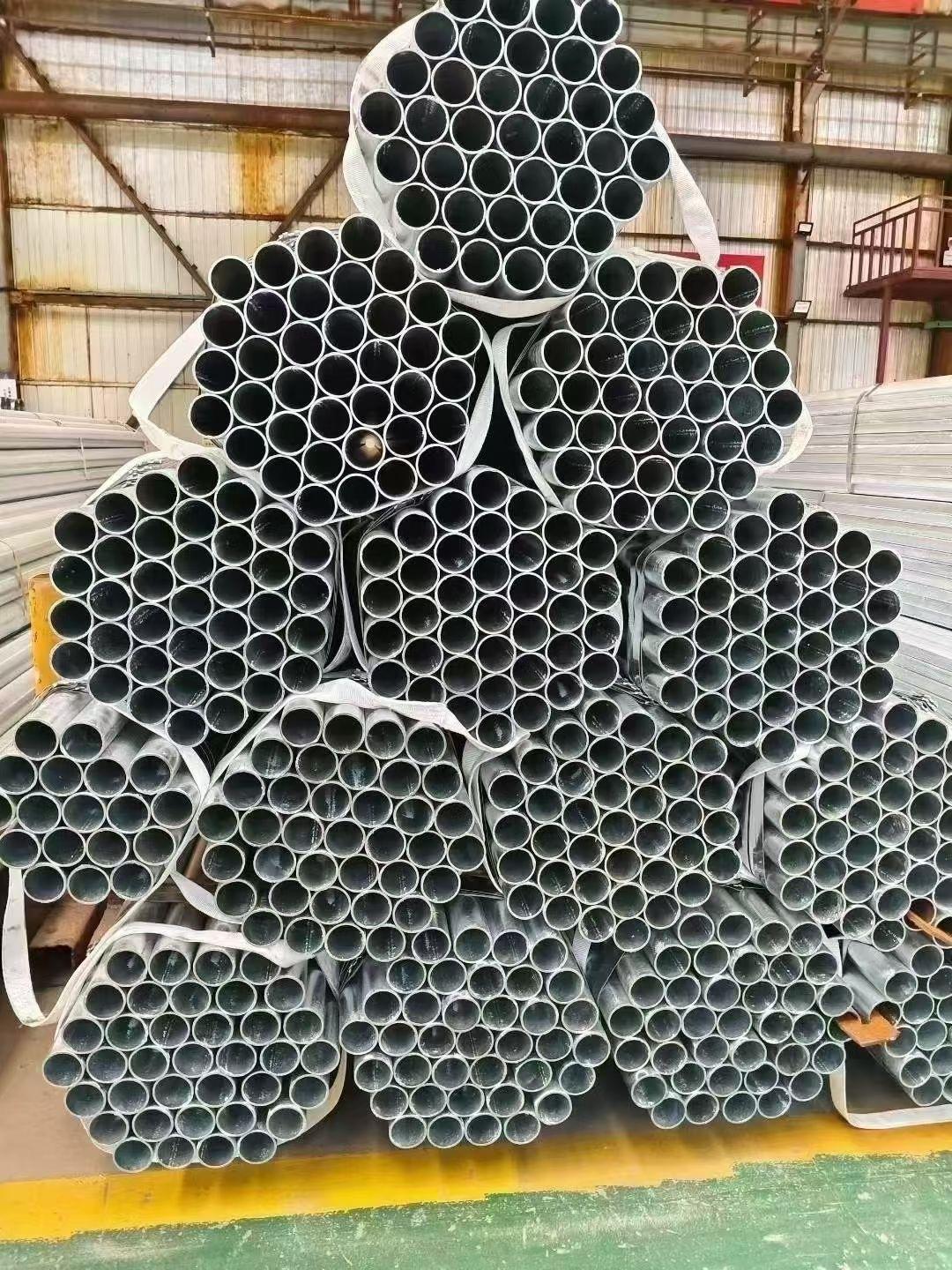
A round pipe doesn't just sit there when salt spray and moisture show up. The curved surface collects a thin film of water almost immediately, and because the pipe is round, the film spreads unevenly as it drains. Salt dissolved in that film breaks into ions, turning the water into a conductive solution. Tiny scratches or mill scale on the steel become anodes, while nearby areas act as cathodes. The result is a quiet electrical current that strips iron atoms from the surface and leaves behind pitting that eats inward faster than uniform rust ever could.
Moisture alone causes slow oxidation, but add salt and the reaction accelerates dramatically. The chloride ions don't just speed up rust formation; they actually disrupt the protective oxide layer that would normally slow corrosion down. As the pit deepens, the environment inside becomes more acidic, which further stabilizes the corrosion cell. Over time, a round pipe can lose wall thickness in specific spots while the rest looks almost untouched—making it dangerously easy to underestimate the damage until a leak or structural failure appears.
From Structural Framing to Agricultural Fencing Where Our Pipes Earn Their Keep
A single pipe can do more than most people imagine. On one job site, it carries the weight of a steel frame, cut and welded into beams that hold up a commercial building. On another, it runs along a pasture line, drilled for wire and set in concrete to keep livestock where they belong. That range isn't a marketing promise—it's just how the material behaves when you stop limiting it to one purpose.
The same wall thickness that handles heavy structural loads also resists the daily abuse of weather, animals, and farm equipment. We've seen contractors order identical bundles for a barn roof and a cattle gate. The difference isn't the pipe; it's the person cutting it. They know a good piece of steel doesn't care whether it ends up in a high-rise or a hog pen.
What really makes the product earn its keep is predictability. When a builder frames a warehouse or a rancher stretches a fence line, both need material that won't twist, crack, or surprise them. Our pipes get used where failure isn't an option. That trust comes from doing the boring stuff right—consistent diameter, clean ends, and enough corrosion resistance to outlast the mortgage on the building or the lifespan of the herd.
Getting the Wall Thickness and Diameter Right Without the Guesswork
Most people pick a wall thickness and diameter by eye, then spend weeks fixing leaks, cracks, or a part that simply won't fit. The two dimensions are not independent choices. A larger diameter with the same wall thickness actually sees higher hoop stress under internal pressure, which means the "safe" tube you selected might be the one that fails first. Before you cut any material, write down the maximum working pressure, the fluid or load it will carry, and the exact clearance you have to work with.
From there, ignore the generic tables that assume ideal conditions. Use the actual yield strength of your material at the highest operating temperature, then add a corrosion allowance if the environment is wet or chemically active. For diameter, measure the mating parts with a calibrated tool, not a tape measure, and account for thermal expansion in both directions. If the calculated wall thickness lands between two standard sizes, go one step up only if the extra weight doesn't create a new problem. A quick hydrostatic test on a short sample will tell you more than any textbook.
Once you have a candidate size, make a short test section and pressurize it beyond the expected maximum, or load it to 1.5 times the design load if it's structural. Watch where it yields or leaks first. That failure point is your real safety margin, not a number on a data sheet. Adjust the wall thickness or diameter by small increments until the failure mode is ductile and predictable, then order the full length with confidence.
Why Some Galvanized Pipes Peel or Flake and How We Avoid That
The flaking or peeling you sometimes see on galvanized pipes rarely comes from a single cause. It often starts with the zinc layer being applied too thickly or unevenly during the hot-dip process. When the coating cools at different rates, internal stress builds up and weak spots form. Over time, exposure to moisture, temperature swings, or even minor physical abrasion can break those weak bonds, causing the outer layer to lift away in patches.
Another common trigger is contamination on the steel surface before galvanizing. If mill scale, rust, or residual oil isn't fully removed during cleaning, the zinc can't bond properly. The result may look fine at first, but after a few seasons of expansion and contraction, those poorly adhered areas start to bubble and detach. Poor drainage design also plays a role: when water collects inside or around the pipe, corrosion works from the inside out, pushing the coating off from beneath.
We avoid these failures by controlling every step before and during galvanizing. Our pre-treatment line uses a combination of abrasive blasting and chemical baths that strip the steel back to a clean, reactive surface. Then we run a slower, tightly monitored withdrawal speed from the zinc bath, which lets the coating form a uniform metallurgical bond rather than a thick, brittle shell. Finally, each pipe gets a visual and adhesion check after cooling. If a section shows any sign of uneven thickness, we re-dip it rather than letting it ship. That discipline keeps our galvanized pipes from peeling, even in demanding outdoor or industrial environments.
Direct Mill Pricing on Hot-Dip Round Pipe Without the Middleman Markup
Buying hot-dip round pipe straight from the mill changes the entire cost structure. You skip the distributor, the broker, and the regional warehouse—each one normally adds their own slice to the final invoice. That markup isn't small; it often ranges from fifteen to thirty percent depending on location and volume. When you deal directly with the production line, the price you see is closer to what the steel actually costs to roll, galvanize, and bundle. This matters most for contractors and fabrication shops that order by the truckload. A few percentage points of savings on a single load can amount to thousands of dollars over a year.
The real advantage isn't just lower numbers on a quote—it's predictable pricing. Mills publish base prices tied to scrap and zinc indexes, and when you buy direct, those adjustments reach you without the lag or padding from middlemen. You also get clearer mill test reports, batch traceability, and faster answers on availability. If a size like 2-inch schedule 40 or 4-inch schedule 80 runs short, the mill can tell you the next production window instead of guessing. That kind of transparency eliminates the back-and-forth that usually eats up a week when going through a reseller.
There are trade-offs, of course. Direct mill orders often require larger minimum tonnage, and you need to plan lead times around rolling schedules rather than pulling from a local yard. But for repeat buyers who know their monthly usage, the savings and consistency outweigh the wait. You also build a direct relationship with the people who actually make the pipe, which pays off when you need custom lengths, special coatings, or quick adjustments to a standing order.
FAQ
The zinc coating bonds metallurgically to the steel, creating a barrier that holds up in humid or mildly corrosive environments far better than paint or electroplating.
Ask for mill test certificates showing coating mass in g/m², typically around 300–500 g/m² depending on standard, and cross-check with an independent lab if the order size justifies it.
They are common in both, but for potable water you need a food-grade epoxy lining or specific certification; raw galvanized pipe is more typical for fencing, scaffolding, and mechanical conduits.
Common outside diameters run from 21.3 mm to 219.1 mm with wall thickness from 1.5 mm to 8 mm, though many mills can roll intermediate sizes on request.
The bath temperature is well below the steel's transformation range, so yield and tensile strength remain essentially unchanged; only the surface gets the zinc-iron alloy layers.
Standard sizes can ship in 15–25 days after deposit, while custom cutting, threading, or grooving may add a week or more depending on the factory's current schedule.
Look for bare spots, lumps, excessive dross inclusions, or a dull gray coating that flakes when scratched; a uniform spangle or matte finish with no exposed steel is a good sign.
Pre-galvanized pipe has a thinner, less durable coating and the cut ends are unprotected; hot-dip coats the entire surface including weld seams and ends after fabrication.
Conclusion
A hot-dip galvanized round pipe often gets judged by its zinc coating, and that's fair. The real difference shows up when the pipe faces years of salt spray, rain, and condensation without the coating turning into a patchwork of rust spots. Cheap galvanizing can look impressive at first, then starts peeling or flaking at the edges once moisture creeps underneath. A proper hot-dip process lets the zinc form a metallurgical bond with the steel, so the layer doesn't just sit on the surface like paint. It flexes with the pipe, survives handling and threading without chipping away, and keeps protecting the steel underneath long after the original structure has been repurposed or moved. In coastal or high-humidity environments, that kind of coating life is what separates a pipe that gets replaced every few years from one that quietly does its job for decades.
Where these round pipes earn their keep is just as varied as the projects themselves. Structural framing, greenhouse arches, cattle pens, fence posts, handrails, even DIY trailer frames all call for a pipe that won't surprise you with inconsistent wall thickness or a diameter that's just slightly off. Getting those dimensions right without guesswork matters because a post that's too thin buckles under load, and a pipe that's too heavy wastes money. Our mill cuts out the middleman markup, so the price you see reflects the steel, the zinc, and the labor, not a chain of distributors adding their own margins. That direct pricing, combined with a coating that stays intact through rough handling and harsh weather, makes these hot-dip galvanized round pipes a practical choice for buyers who prefer to buy once and forget about the material instead of budgeting for early replacement.
Contact Us
Contact Person: Max Zhou
Email: [email protected]
Tel/WhatsApp: +86 15712216177
Website: https://www.shunchensteelmaterial.com/